

/prod01/channel_23/black-box/media/microsites/black-box/Blue-Goggles-and-Ducting-by-Katherine-Smith-1.webp)
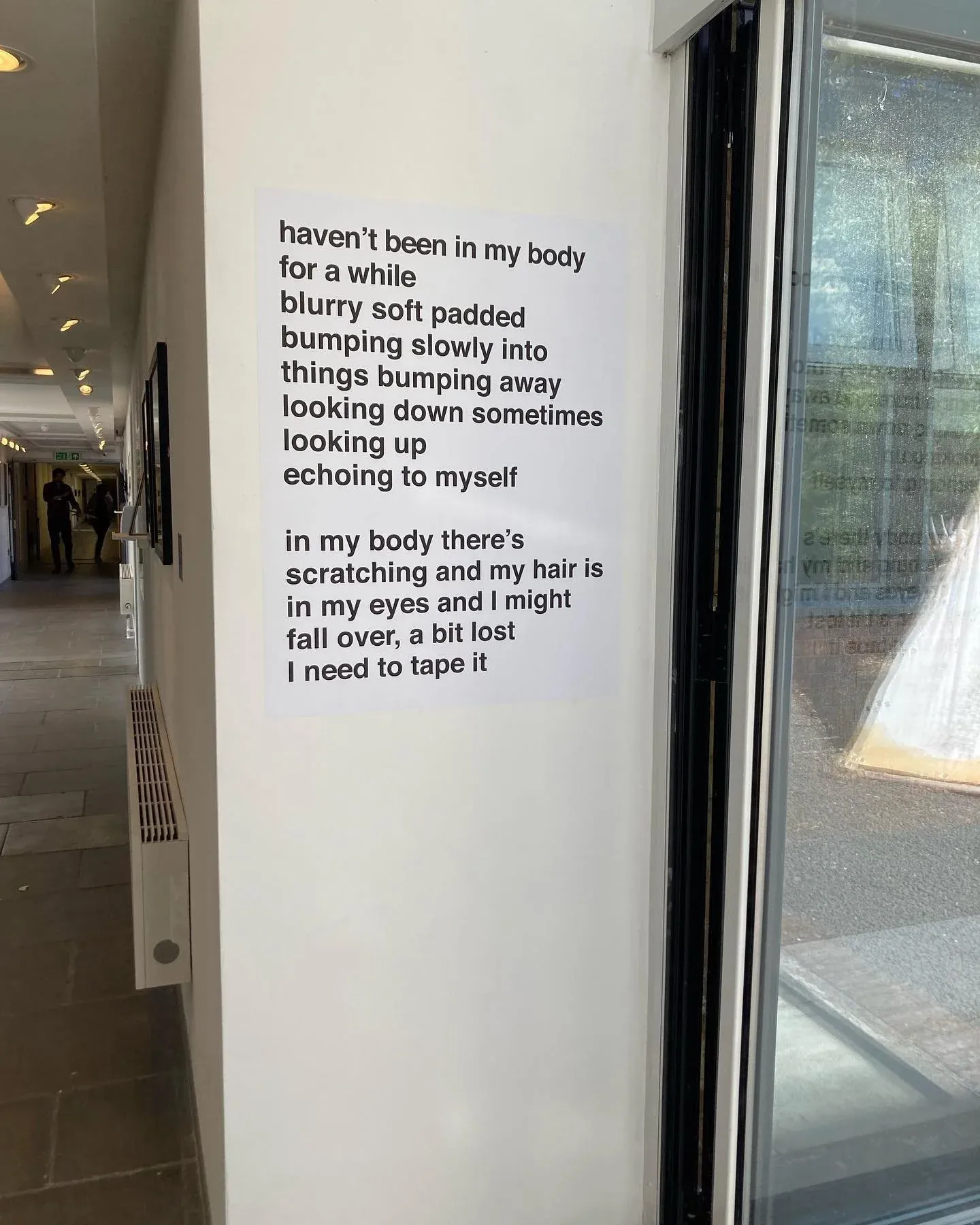
"blue goggles and ducting" is a film/installation with multiple media, the film is Katherine's response to the Black Box space as she worked with the curation team to install the work.
Event details
-
9 June 2022 - 7 July 2022
00:00-00:00 (UK GMT)
Black Box Gallery, UCA Farnham
About the artist
Transcript
Hello! My name is Katherine, this is my studio. I am a performance artist and sculptor and I also work with children in hospitals / galleries / community centres which I see as practice-based research for my studio work, and the other way round too.
The work is an investigation into embodiment, into how to connect to the body, using materials as an interface. I am neurodivergent, I have ADHD, and for me this means that I can find bodily, non-verbal language easier than the verbal. I also have experience of dissociation; so in my practice I am trying to connect back to my body, and through this, to others too.
My practice relates strongly to play theorists like Stuart Lester, Wendy Russell, phenomenologists such as Maurice Merleau-Ponty, Hans-Georg Gadamer, pedagogical theorists such as Paolo Freire, bell hooks. Joanna Grace’s work for individuals with Profound and Multiple Learning Disabilities and her book – Sensory Being for Sensory Beings – is a strong influence.
So, what sort of materials facilitate embodiment?
I’ve particularly seen in my work with children in hospital that this is different for everyone; how we approach materials – and by materials I mean what we want to work with, which can be anything really – depends so much on our life experience, our own experience of embodiment. So my practice has been an investigation into how I choose my materials – what facilitates embodiment for me.
I am drawn to materials that are really responsive / sensitive to the body, that easily connect sound and touch through bodily action.
These pipes reverberate easily and create different tones of sound, vibrations, depending on where they are brought together and what types of movement are used to bring them together.
So a big part of my practice is gathering materials that are responsive to my body. And then, once I’ve done this, I work with them, play with them, experiment with them. I love Elly Thomas’ practice and she talked a lot about spending time with materials; it was really important to her. So I look at how can I spend time with materials? How can I get to know them? The work is about me though, about my projections onto materials: through spending time with materials I spend time with myself.
So, through spending time playing with materials, being present to myself and to the materials, I find moments that surprise me / that aren’t what I expect / in which the material shows me something / teaches me something about it / about my own reactions to it / my own body. And then the works I create are based on this moment – how to investigate what this moment is, this unknown wobble / shake / discovery between us.
In Walking on Tin Cans, I was interested in the vibration that went through my body as I walked in the shoes and the feeling of incorporation – that I was sensing the floor through the vibration of the shoes, not really sensing the shoes as an external object to the body. But, with the shoes, at certain points in the movements, e.g. when the shoes scraped, it became clear that they were not part of me. So to walk in the shoes was strange – feeling that the shoes were part of me – for example when lifted in the air – and then not. It made me very aware of my body and the shoes, the connection between them, the joining point.
On another level, this work was also very much about isolation and the difficulty of connection; I am alone on the stage, not really connecting to the audience with my body at all, focusing on my own path around the stage. The piece could seem like an example of dissociation / disconnection, rather than embodiment. However, there is also humour / absurdity: going for a walk in these giant, clanky shoes. The idea of failing to connect is held gently, slowly. Acknowledging the failure to connect is connecting.
This tension between disconnection and connection, through working with materials, is something I look at in the next piece too.
In Dancing in Scaffolding Foam I further developed ideas about incorporation, isolation / connection. The body sock is a grounding, proprioceptive tool, telling my body where it is in space, and it is also a shield. The tension between isolation and connection is in general at the core of my work. It is important to connect with ourselves and others, and at the same time very difficult.
In the piece, I was looking at the sound of the noodles when they bumped together. What I wanted to do at the start of this was to stick all the foam noodles onto the body sock. But it wasn’t working out; I tried a couple of different glues and couldn’t make the join stable enough. Then I realised I wasn’t really being present / open to the material itself, it was more about what I wanted and me controlling it. So when I realised this, the piece then became an acceptance of that, an acceptance of what the material wanted to do. I set up the task of dancing to get all the foam noodles off my body, and what was exciting was this task was set up with a deep understanding of the material properties; the task was kind of co-created between me and the material. And the task taught me a lot: the sounds of the noodles changed as they fell off and there were fewer on the suit; the movements that I made were not movements I had pre-planned / known about before the piece. So then I started looking at task-based play.
I looked at this more in this piece, 4 piece scaffolding pole. I developed the task of balancing the 4 pieces on top of each other over time, through working first with a 3 piece scaffolding pole, which was quite easy for me to balance. It as in fact too easy – and I didn’t really get into the task because of this. I didn’t really discover anything about my body / the material, and it was over very quickly. Therefore I decided to split the pole into 4, which was a lot more challenging. So I realised that creating situations of effort / challenge, that I have chosen, can be a factor in facilitating embodiment. In writing about task-based play recently, and how to develop tasks that are appropriate for our bodies, I spoke to Tehching Hsieh, an amazing performance artist. In Time Clock Piece he said that he chose to punch a clock every hour on the hour for a year, because this rhythm was good for his body, his expression; he was developing a rule for himself that suited his capacities. I find this very interesting – how we develop structures that suit our own bodies.
So, how does all this translate to my work with children?
In terms of external structures, I’ve wanted to work within framework that prioritise play. Since 2014 I’ve been running group sessions focused on creative expression in community spaces. The focus has been on materials and the potential of materials to act as a starting point for role-play, creativity, world-building. For the last 18 months I’ve done quite a lot of work with the Great Ormond Street Hospital play team; I’ve also worked with the Polka Theatre, a children’s theatre, St George’s Hospital Play Team and different community spaces and play-focused gallery spaces.
So what are the internal structures to the sessions? Sometimes in this work I just bring materials; materials can provide all the structure that is needed for the particular children and setting of the session. As I investigate in my studio work, materials can invite you to roll them / to stick them / to scrunch them / to jump on them / to handle them in certain ways / to combine them with other materials that fit well with them. In a festival in 2018 for a three day project called ‘Build an Imaginary World’ we collected waste, recycling materials each morning from the festival, and then built them into a communal imaginary world. These materials, which are easily transformed, are a really good starting point for facilitating play / embodied making.
In a hospital context I’ve sometimes translated this to create a world in a box – a world with all the child’s likes and dislikes. I’ve seen that this can be a good starting point for some children, as it makes clear that the session is all about them – their likes / dislikes – their experience. From there, the child can tell me what they want to do next / we can make a decision together.
So, for some children, in some settings, the materials can provide the structure for the session, acting as an interface to a way to build and make together.
For other sessions, we might need a more specific starting point, some sort of task to get started.
At South London Gallery recently I provided each child with a silver sack – a material I’ve seen is appealing and easy to use for many children – and I also gave them a checklist of movements to make with the sack. This checklist was just a suggestion – there as a starting point if they wanted it. The checklist was sort of a way to hold space for new things to take place. This is similar to what I did a couple of years ago with What is a Wheel at Thought Foundation, Aspex and Chapel Arts Studio. On the checklists both times were ‘invent a movement for the wheel/sack’. So the checklist contained within it the possibility of newness. It could also be totally discarded when the child was ready.
Working with children with PMLD, I developed different small sculptures / accumulations of material to provide a structure for the session. Some of these sessions were on zoom, and I gave the playworker in the room with the child the same sculpture that I had on zoom. I moved with the sculpture in different ways, creating sounds / rhythms through touching the sculpture. The child would communicate with the player worker through touch / small movements to say whether they wanted more of the material I was offering, or not. So to work with the child in these sessions was a constant process of learning about the child and their bodily reactions to the material.
So how do I translate these ideas about play, the body, materials, to working with children?
I’ve realised through working with children for many years, that facilitating art and play needs to be an incremental process of working out what works for each child / group of children. If I want the child to feel safe to make choices, to discover and play with materials, I know that the most important thing is to respond in the moment to the child – to who they are. And this is done through spending time with them – noticing the choices that they make and responding to them.
It’s about noticing what the child wants from tiny cues / gestures that might not be verbal. Through being aware, which is a constant process of learning and reflection, and of course I may make mistakes which I then reflect on, improve on, I can hold a space that is as open / safe / nurturing as possible for the child, so that they can create an embodied structure for their own play and art, a structure that is not imposed by me.
Contact us
Drop us a message for any enquires, collaborations, exhibitions or general interest.